
What it costs to open a self-serve, in-bay automatic or tunnel wash, how much each type typically earns, the licences and site decisions that trip up first-time owners, and the technology choices that decide whether you build a single-wash business or a membership business. Written by the team behind Repoint, with figures from public industry sources linked at the bottom.
Startup cost and daily operations depend almost entirely on which format you choose. Industry figures compiled by ProjectionHub from ISS, Car Wash Advisory and JBS Industries put the ranges roughly as follows; your market, land cost and equipment choices will move them.
Roughly $15,000 to $25,000 of equipment per bay plus a simple building and land. Revenue of about $1,000 to $1,500 per bay per month is typical. Unattended, cash-and-card, and increasingly converted to tap-to-pay.
Plan on at least $250,000 per bay: around $150,000 of equipment and $100,000 for the building. Average revenue sits near $139,000 a year per site. Unattended, and the format where a membership-selling pay station changes the math most.
$2.5 million to $7 million to build. Average tunnel revenue is about $685,000 a year at roughly $15 a wash, and the strongest sites earn far more on unlimited memberships. Labor, throughput and the club decide the outcome.
Daily traffic count, visibility from the road, ease of entry and exit, and room for a queue. A great wash on a bad corner stays empty.
Washes are water and electricity businesses. Confirm capacity, reclaim requirements and sewer fees with the municipality before you buy the lot.
Commercial zoning, environmental and stormwater approvals, signage permits, and in many areas a water-reclaim requirement. Budget months, not weeks.
Existing washes list from tens of thousands for a tired self-serve to many millions for a recent tunnel, typically valued at 4.6 to 6 times EBITDA. Buying skips permits; building skips someone else's problems.
Choose equipment you can get serviced locally. Ask every vendor what the controller is, because that decides which POS and pay station you can run later.
SBA 7(a) loans run up to $5 million with roughly 10% from the owner or investors. Equipment financing and trade-in credit on hardware reduce the cash needed at open.
Unattended with a pay station, attended with a handheld in the lane, or both. The choice sets your largest ongoing cost and your hours of operation.
Decide your single-wash menu and your unlimited tiers together. Dynamic pricing for peak days and a club that renews itself are the two levers that most change year-one revenue.
A simplified timeline that most new owners follow, whatever the format.
Business plan with the figures above adjusted to your market, financing secured, site under contract, permits and utilities applied for. This is the long pole.
Construction or refurbishment, equipment installed and commissioned, pay station and controller wired in, pumps integrated if you have fuel.
Run friends-and-family washes to tune the equipment, train staff on the handheld, then open with the membership offer on every screen from day one.
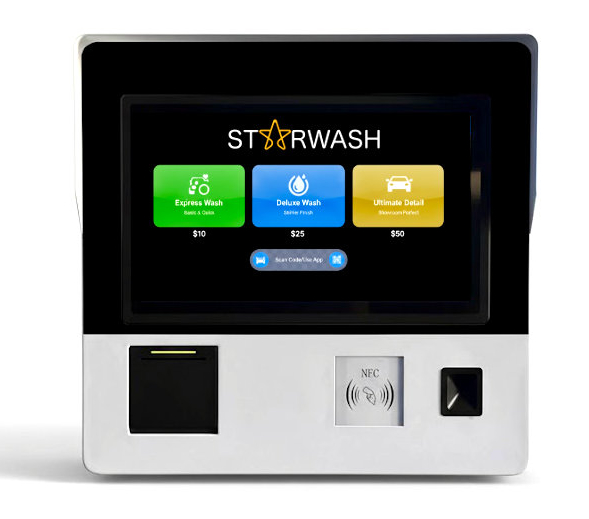
The single biggest difference between washes that struggle and washes that compound is recurring revenue. That decision is made when you choose the point of sale, because the POS decides whether a card tap at the entrance can become a member, whether a plate opens the gate, and whether you can run the site from your phone.
Figures on this page are industry estimates, not quotes. Check them against your own market before you borrow against them.
Industry estimates range from about $50,000 for a small self-serve to $7 million for a new express tunnel. Self-serve bays run roughly $15,000 to $25,000 in equipment each plus a building; in-bay automatics at least $250,000 per bay; tunnels $2.5 million and up. Land and local permits move every number.
Public estimates put a self-serve bay at $1,000 to $1,500 a month, an in-bay automatic at around $139,000 a year, and an express tunnel at about $685,000 a year on average. Membership-heavy sites earn more and more predictably.
Self-serve and in-bay formats carry high gross margins because there is little labor in the cost of each wash; tunnels earn more but carry staff. In every format, unlimited memberships are what turn weather-dependent sales into recurring revenue.
Buying skips permitting and opens faster, and existing washes are typically valued at 4.6 to 6 times EBITDA. Building lets you pick the site and the equipment. Either way, budget to modernize the pay station and POS so the wash can sell memberships.
Commercial zoning, a business licence, building permits, environmental and stormwater approvals, signage permits and in many jurisdictions water-reclaim requirements. Start with the municipality and the water utility before you commit to a site.
Yes. Self-serve and in-bay automatic washes commonly run unattended with a pay station that takes cards, mobile wallets and memberships. Remote cameras and support cover the rare stuck customer.
A controller for the equipment, a pay station or kiosk at the entrance, a membership engine, and reporting you can see from your phone. Buying them as one system avoids three vendors who disagree when a price changes.
Talk to a wash specialist. We will walk through your format, your site and your equipment list, and show you how the kiosk, controller and membership engine fit together before you buy anything.
Book a 20-minute call with a wash specialist. Bring your site and equipment list and we'll map the technology before you buy it.